Beginner Tips for Learning Different Circus Apparatuses

So you want to get in the air? YES. I love this for you. Stepping into circus arts is one of the most exciting things you can do for your body, your brain, and honestly your whole outlook on life. Each apparatus has its own personality, its own feel, its own demands, its own magic. Whether you are drawn to the hammock, silks, lyra, bungee, sling, or dance trapeze, the right habits from day one will set you up for safe, joyful progress. Here is what I want every beginner to know.

Build Your Foundation First

Before you climb, spin, or fly, you need a base. Core strength, shoulder stability, grip endurance. These are what every single apparatus is going to ask of you. Planks, hollow holds, scapular engagement drills, mobility work. I know it does not sound as fun as being in the air, but trust me. Strong basics make everything smoother and help you avoid the overuse injuries that slow people down. We build from the ground up. Always.

Learn the Language

Every apparatus has its own vocabulary, and learning it early is going to make your training so much easier. In the hammock and sling, we talk about wraps, seats, and inversions. Silks add climbs, footlocks, and pathways. Lyra is all about mounts, balances, and transitions. Dance trapeze blends static shapes with swinging momentum. Bungee is about rebound mechanics and timing your body in a whole new way. When you understand the terms, you can follow instruction more easily and start to see the patterns connecting everything. That is when it really gets fun.

Stay Low. Work Your Technique.

I see this all the time. New students want to go high right away. I get it! But circus rewards precision way more than altitude. Working close to the ground is where you figure out your wraps, refine your form, and build real confidence. Once your technique is solid and consistent, height is the natural next step. There are no shortcuts here, and honestly, you do not want them.

Fall in Love With Repetition

Circus skills are built through repetition. That is just the truth. Pathways get smoother, your strength grows, your aerial awareness develops. All of it happens over time and through consistent practice. Celebrate the small wins. A cleaner line. A steadier balance. A smoother mount. Progress is not always linear, but if you keep showing up, it always comes. I promise you that.

Listen to Your Body

This one is huge. Circus training is demanding, and recovery is part of the process. Soreness after a new skill or a tough class? That is normal. Sharp pain? Stop. Rest days, stretching, and mobility work are not optional extras. They are what keep you in this long term. Learning to tell the difference between productive fatigue and actual strain is a skill every aerial artist develops. Your body is smart. Listen to it.

Benefits of Each Apparatus

Not sure which apparatus is calling your name? Here is a breakdown of what each one brings to your training. The good news is, you do not have to choose just one.

Aerial Hammock

  • Builds full-body strength through progressions that work for every level

  • Supports flexibility training through wraps and assisted stretches

  • Offers a beautiful, gentle introduction to inversions and aerial awareness, where a lot of people first fall in love with being upside down

Aerial Sling

  • A creativity machine that rewards people who love to explore dynamic sequencing and flow

  • Provides stable support for learning wraps and drops safely

  • Builds serious grip and core strength through controlled pathways

Aerial Silks

  • Develops powerful upper-body and core strength

  • Demands precision, coordination, and real problem-solving as you work through wraps

  • Offers endless progression, from your very first climb all the way to beautiful advanced drops. It never stops challenging you.

Lyra (Aerial Hoop)

  • Builds balanced strength in your shoulders, back, and core

  • Improves your body lines, shapes, and transitions

  • Builds confidence fast through spinning and controlled movement. There is something so empowering about feeling in control up on that hoop.

Bungee Fitness

  • Low impact, high energy, and SO much fun

  • Improves coordination, timing, and rebound control in ways that surprise people

  • Builds leg and core strength while being kind to your joints. It is truly for everybody, which is why we also offer Bungee GOLD for students 55 and up.

Dance Trapeze

  • Combines aerial technique with fluid, dance-based movement

  • Builds dynamic stability through swinging and momentum

  • Lets your musicality and artistry shine. This one is for the movers and the expressers.

You Belong Here

No matter where you start, I want you to know this: you belong here. We have had students from 8 to 81 walk through our doors saying "I can't do this." And they did it.

My teaching philosophy is simple. I am here to help people shine their brightest, wherever they are. My job is to help you feel your best and have fun doing it.

If you are curious about any of these apparatuses, come check out one of our intro classes. Every single apparatus at Aerial Fun and Fitness has an intro class that everyone starts with. No experience needed. No special body type required. Just show up and give yourself a chance.

See you in the air! You are amazing.

Zina's Aerialsophy - Straddle Strike Pancake Pike

Zina's Aerialsophy

This month's tip is all about two beautiful shapes we use a lot in  dance and aerial arts: the Straddle Strike and the Pancake Shape.  Can you spot the difference?  They shapes we can make in the air and on the ground, right side up and upside down. 

What is a Straddle Strike?
In aerials, a straddle strike is when you sit up, open your legs out wide to the sides — with strong, active legs. Your hips are at a 90 degree angle and you keep your core engaged. You can be sitting, standing, suspended  or upside down in the air when you strike this shape.  This is also considered and safety shape for cross backs in fabric.  If you pancake too much you could slip out of your wrap.   Think sit your bum on the ceiling and not fold.  Which takes us to the next shape.

What is a Pancake Shape?
From the wide straddle, you hinge at the hips and fold your torso forward between your legs. Imagine trying to flatten your chest toward the ground (or the floor if you’re upright). This creates the beautiful, long "pancake" line we love to use in poses and transitions. It’s a strong stretch that challenges your flexibility and core control!

Where You’ll See These Shapes

  • Entering and exiting tricks like front balance, hip key, or straddle back.

  • Conditioning exercises to build hip mobility and hamstring flexibility.

  • Posing for flowy, graceful transitions in choreography.

Zina’s Quick Tips

  • Stay Active: Pull those quads tight and point or flex your ankles/arch/toes with purpose. Keep your legs strong in either position.

  • Control Your Fold: Engage your core so you fold with strength, or to hold the 90 angle in your hips.

  • Check Your Support:  in wraps.... Can you tell/feel the difference in these shapes in the air?

These shapes are not just about flexibility — they build strength, control, and confidence in your aerial movement!

Zina's Aerialosophy - Peace and Love Injury Protection

Zina's Aerialsophy

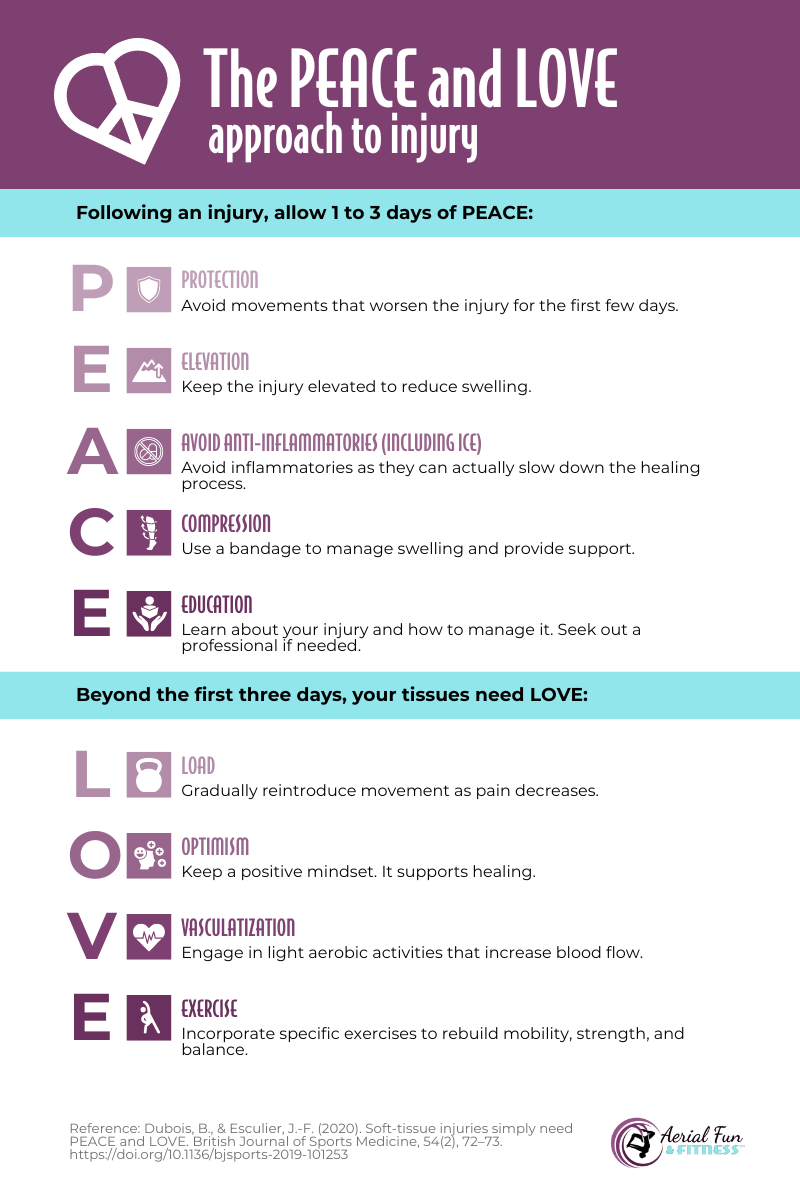
In aerial fitness, injury prevention is key to staying safe while having fun. The PEACE and LOVE method is a simple approach to help manage injuries and support recovery, both short-term and long-term.

PEACE

When an injury first happens, follow PEACE to minimize damage and start healing:

  1. P – Protect: Avoid moves or tricks that could make the injury worse.

  2. E – Elevate: Raise the injured area above your heart to reduce swelling.

  3. A – Avoid anti-inflammatories: These can slow healing, so let your body do its thing naturally.

  4. C – Compress: Gently wrap or compress the area to control swelling.

  5. E – Educate: Learn about your injury and listen to your body to avoid overdoing it.

LOVE

Once the injury starts healing, switch to the LOVE method to recover fully:

  1. L – Load: Gradually reintroduce movement and weight to strengthen the injury.

  2. O – Optimism: Stay positive—recovery is just as much mental as physical.

  3. V – Vascularization: Keep blood flowing with light exercise, like gentle stretching or walking.

  4. E – Exercise: Regularly work on strengthening and flexibility to prevent future injuries.

By following PEACE and LOVE, you can manage injuries smartly and get back in the air safely. Aerial fitness is all about balance—both in the body and the mind!

Teacher Training Updates

We’ve got something exciting in the works—a brand-new Hip and Core Challenge! Get ready to fire up your muscles and strengthen your practice or learn the details to have safe splits and back bends in a whole new way. More details are coming your way soon, so stay tuned!

It is time for Showcase!

** Teacher Tidbits Corner - Kelsey DeMonte - September 2021
------------------------------------------------------------
You’ve signed up for the Aerial Fun and Fitness Student Showcase this year... so now what?

The student showcase is your opportunity to show your friends, family, and yourself how far you’ve come with your aerial skills. This year, due to COVID, we will be holding the showcase via a live Zoom viewing party mid-November! You might think November is awfully far away, but
here’s a quick breakdown of how we plan our student showcase:
* Students were given the month of July to sign up for our student showcase via Google Forms survey, and the survey closed on August 1st.
* During the month of August, Zina and Kelsey will be working together to assign all students into group pieces and choreographing those pieces. You will hear from us in August with your assigned group and rehearsal time!
* Showcase rehearsals will start during the first week of September. Groups will rehearse once a week, and additional rehearsals may be added as we get closer to the showcase as necessary.
* The first week of November, all group pieces will be professionally filmed. Our wonderful videographers will take the footage and edit it prior to our live viewing party.

Are you new to the student showcase or looking for some tips to make this process as fun and successful as possible? Here are our keys to success in the student showcase:
* Attend as many of your scheduled group rehearsals as possible! This ensures that you have enough time to learn the choreography and commit it all to muscle memory so that when the time comes to perform, you are not as stressed about remembering each step. This also builds comradery within the group and allows everyone to work together cohesively.
* Figure out what your best way of learning is! We tape and share rehearsal videos so you can refer back to them as needed. Some of our favorite memory strategies are watching the rehearsal videos over and over, recording your own voice saying the steps over the music, writing down the sequence of steps, etc. Find what works best for you!
* Go into showcase rehearsals with an open mind and positive attitude! Remember- we have plenty of time from the start of rehearsals until our viewing party to learn and perfect our pieces. They might not look or feel great right from the start, and that is 100% okay! The learning curve for every student will be different, and we promise that with time and practice, all of you will look great by November and have the greatest sense of pride in your hard work.
* HAVE FUN! This is our favorite time of the year not only because you all get to show off all of your hard work, but we get to know all of you so much better. We always talk about how we at Aerial Fun and Fitness are truly an aerial family, and this is magnified during showcase season!